
European Ecotourism
European ecotourism offers an impressive diversity of natural landscapes, from glaciers in the north to arid steppes in the south. It has rugged mountain ranges, tranquil wetlands, Mediterranean coastlines, and boreal forests. National parks, sustainable accommodations, and small villages offer travelers the chance to travel responsibly while enjoying unique biodiversity and local culture.
Europe – Eco lodges and Eco Tours


Ecotourism and Sustainable Tourism in Europe
Europe may be relatively small, but the continent offers an impressive diversity of landscapes and ecosystems. Ecotourists have countless opportunities to explore pristine nature, spot rare animals, and support sustainable initiatives. Awareness of sustainable travel is growing throughout Europe. More travelers are choosing the following:
- Europe boasts numerous protected natural areas, including national parks, Natura 2000 sites (a network of protected areas covering Europe’s most valuable and threatened species and habitats.), and UNESCO Biosphere Reserves. These sites offer fantastic opportunities for hiking, birdwatching, and sailing.
- Eco-certified accommodation (such as “Clé Verte” or “EU Ecolabel“. These are European classifications).
- Mindful Travel/Slow Travel (e.g., by train or bicycle).
- Local, and seasonal products, as well as community projects.
- Conservation and participatory tourism, such as working on organic farms (WWOOF) or taking guided walks with local nature guides.
European Ecotourism – UK
Landscape, flora, and fauna
In the United Kingdom, you’ll discover dramatic coastal cliffs, vast heathlands, and even ancient rainforests in Wales and Scotland. The United Kingdom is a surprisingly green destination for ecotourism. Despite its dense population, there are vast nature reserves, national parks, and islands where sustainability is central. Flora includes oak, beech, and heather. Wildlife includes red deer, foxes, seals, puffins, and the European robin.
Best Time to Visit
May to September is ideal for Ecotourism in the UK. Spring brings wildflowers and bird migrations. Summer offers long daylight hours for hiking and wildlife watching. Early autumn is quieter and perfect for coastal walks, birdwatching, and exploring national parks.
Ecotourism in the UK revolves around small-scale travel, conservation, and discovering local communities. All with a small environmental footprint.
Top Destinations
Lake District in England. England’s largest national park is famous for its lakes, mountains, and hiking trails. You can reach the area by train to Oxenholme or Windermere, and from there by local buses or bicycle.
Cairngorms National Park in Scotland. This Highland Park is a paradise for nature lovers. It has ancient Caledonian forests, rare animals like wildcats, and countless eco-activities. The park is accessible by train to Aviemore or Inverness, and from there by bus or bike to the villages and trails.
Pembrokeshire Coast in Wales. This coastline combines cliffs, beaches, and a 300-km-long walking trail. Sustainable tourism is highly valued here. The best time to visit is from May to September, when the weather is mild and nature is in full swing. Travel by train to Haverfordwest or Fishguard and continue by local buses.
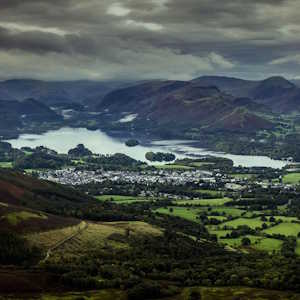 Destination UK
Sustainable Transportation
The UK supports European Ecotourism with strong sustainable transport. Railways connect cities, national parks, and coastal regions. Cycling routes such as the National Cycle Network cover the country. Electric buses and urban bike-share programs are growing. Ferries connect eco-destinations like the Hebrides.
European Ecotourism – Iceland
Landscape, flora, and fauna
In Iceland, rugged volcanic landscapes, glaciers, bubbling geysers, and waterfalls dominate the landscape. Iceland is a true paradise for European ecotourism enthusiasts. The country is strongly committed to sustainability. Energy comes almost entirely from renewable sources. Nature reserves are carefully protected, and many accommodations are eco-certified. Vegetation is sparse but unique. Mosses and lichens cover volcanic terrain. Wildlife includes Arctic foxes, puffins, whales, and seals.
Best Time to Visit
June to September is best for European Ecotourism in Iceland. Long daylight hours allow extensive exploration. Roads to highland areas are open. Summer is ideal for hiking, whale watching, and seeing bird colonies. Spring and autumn are quieter.
Ecotourism in Iceland means traveling with respect: enjoying breathtaking nature while minimizing your footprint.
Top Destinations
Þingvellir National Park. This UNESCO World Heritage site combines nature and history. You literally walk between the North American and Eurasian tectonic plates. From Reykjavik, you can easily reach Þingvellir by rental car, an organized bus tour, or local bus line that serves the Golden Circle. Which is a famous 190 mile scenic loop.
Westfjords of Hornstrandir Nature Reserve. This remote area offers tranquility and unspoiled nature. It is ideal for birdwatching (puffins!) and is accessible. The flora and fauna may be in full bloom, depending on when you go. Access is by ferry from Ísafjörður.
Vatnajökull National Park. With Europe’s largest glacier, this park is a hotspot for eco-adventure. You can enjoy sustainable glacier hikes with certified guides and visit impressive waterfalls like Svartifoss. Transportation is via the Ring Road (Route 1) with a rental car or long-distance buses that connect the south and east of Iceland.
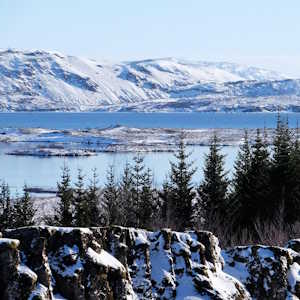 Destination Iceland
Sustainable Transportation
Iceland promotes sustainable travel for European Ecotourism visitors. Electric car rentals are increasing and charging stations are expanding nationwide. Public buses connect towns and some natural sites. Guided eco-tours, hiking routes, and responsible whale-watching reduce environmental impact.
European Ecotourism – France
Landscape, flora, and fauna
France is not only the land of wine and culture. It is also a top destination for ecotourism. The country boasts unparalleled diversity. From the soaring peaks of the Alps to the marshes of the Camargue and the expansive beaches of the Atlantic coast. In the Camargue, you’ll see flamingos and wild horses. While in the Alps, chamois and blooming lavender fields will enhance your hiking.
Best Time to Visit
May to October is excellent for European Ecotourism in France. Spring brings wildflowers and active wildlife. Summer is ideal for alpine hiking and nature reserves. Best time to visit the Camargue is April to June or September, when temperatures are pleasant and migratory birds are plentiful. Early autumn offers mild weather and fewer visitors. Wetlands become important bird migration sites.
Ecotourism in France means traveling with respect for nature and tradition while enjoying one of the most diverse landscapes in Europe.
Top destinations
The Camargue in Provence. This is a paradise for birdwatchers and nature lovers. Temperatures are pleasant and migratory birds are plentiful from April to September. You can reach the Camargue by train.
Vanoise National Park in the Alps. France’s oldest national park offers glaciers, alpine meadows, and rich wildlife, including ibex and marmots. The Park is perfect for hikers and mountain enthusiasts. It is accessible by train to Chambéry or Bourg-Saint-Maurice, and then by bus or cable car to the villages surrounding the park.
The Dordogne Valley: This is a green region full of rivers, castles, and prehistoric caves. Here you can enjoy sustainable canoeing, bicycling, and discover local organic products. Travel by train to one of the many small towns in the Dordogne.
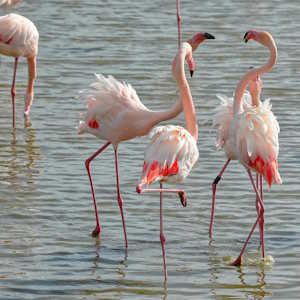 Destination France
Sustainable Transportation
France offers strong options for European Ecotourism travel. High-speed TGV trains connect major regions. Regional trains reach rural landscapes and national parks. Cities support cycling with extensive bike lanes. Electric buses and rail travel provide low-carbon alternatives to flights.
European Ecotourism – Spain
Landscape, flora, and fauna
Spain‘s landscapes range from Mediterranean coasts to mountains and semi-arid plains. Cork oak forests and wetlands support rich biodiversity. Wildlife includes Iberian lynx, Spanish imperial eagles, and griffon vultures. Doñana wetlands, in Andalusia, hosts large numbers of migratory birds.
Best Time to Visit
Spring and autumn are best for European Ecotourism in Spain. April to June brings wildflowers and bird migration. September and October offer cooler weather for hiking and wildlife watching. National parks are more comfortable outside the hot summer months.
Ecotourism in Spain means choosing small-scale initiatives, nature conservation, and local connections. In this way, you discover a country full of contrasts with a minimal ecological footprint.
Top destinations
La Gomera in the Canary Islands. This island is known for its laurel forests in Garajonay National Park. The Park is a hotspot for ecotourism and hiking. Access is by ferry from Tenerife or domestic flight from other Canary Islands.
Doñana National Park, in Andalusia.
This UNESCO World Heritage site is a birdwatcher’s paradise and home to the critically endangered Iberian lynx. You can reach Doñana via Seville or Jerez de la Frontera by train or bus, and then by rental car.
Picos de Europa, in Asturias, Cantabria, and León. This mountain range offers spectacular hiking trails, deep gorges, and traditional villages where sustainable tourism is key. It is ideal for hikers and nature lovers.
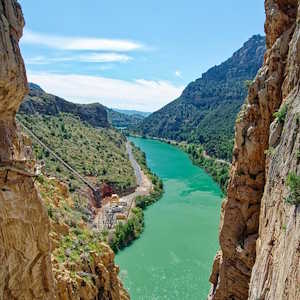 Destination Spain
Sustainable Transportation
Spain supports European Ecotourism with modern rail networks. High-speed AVE trains connect many regions. Regional trains and buses reach national parks and nature reserves. Cycling routes and long-distance trails promote slow travel and low environmental impact.
Sustainable Travel in Europe – How to Get around
The best ways to travel sustainably:
- Train travel: Europe has an excellent rail network via Interrail, Eurostar, TGV, and night trains, often using green energy. Europe is advancing green energy through a mix of renewable electricity sources, like wind and solar, and emerging hydrogen train technology. This is perfect for slow travel.
- Cycling and walking: cycling routes such as the EuroVelo network connect dozens of countries. Combined with trains, they are perfect for nature trips.
- Electric (shared) cars: in countries like France, Germany, and the Netherlands, electric shared cars are becoming increasingly accessible. Carpooling or electric rental cars are a good option for remote areas.
- Local overnight stays: choose eco lodges, agriturismos, or small-scale B&Bs with eco-certifications (such as Clé Verte or EU Ecolabel).
European Landscape
Flora
Europe’s flora is incredibly diverse. This variety is due to the interplay of climate, altitude, soil types, and its location between the Atlantic Ocean, the Mediterranean Sea, as well as the Arctic. Europe can be broadly divided into a few major vegetation zones:
Arctic and Subarctic Flora
- Regions: Iceland, northern Norway, Sweden, Finland, and parts of Russia (23 percent of it’s landsacape is in Europe).
- Characteristic plants: lichens, mosses, Arctic willow, dwarf birch, and Arctic flowers such as mountain sandwort and Arctic poppy.
- Adaptation: these plants are low-growing and can tolerate extreme cold, wind, and short growing seasons.
Boreal Forests/taiga
- Areas: large parts of Scandinavia and northern Russia.
- Dominant species: Scots pine, Norway spruce, silver fir, and birch.
- Remarkable: soils are often covered with bilberries, peat moss, and reindeer moss. These forests are important for biodiversity and carbon storage.
Temperate Deciduous Forests
- Areas: Central and Western Europe, including France, Germany, Poland, and the United Kingdom.
- Tree species: beech, oak, hornbeam, maple, and ash.
- Understory: wild hyacinth, wood anemone, and Solomon’s seal. These forests display beautiful colors in autumn.
Mountain Flora (Alps, Pyrenees, Carpathians)
- Areas: high mountains spread across Europe.
- Characteristic plants: edelweiss, alpine rose, gentian, and mountain anemone.
- Adaptation: these plants are often cushion-shaped, with hairy leaves or a thick waxy layer to protect against cold and wind.
Mediterranean Vegetation
- Areas: Spain, Italy, Greece, southern France, and Croatia.
- Typical Plants: cork oak, holm oak, olive tree, rosemary, lavender, and thyme.
- Characteristics: many species are evergreen, have small, leathery leaves, and tolerate drought well.
Steppes and Dry Grasslands
- Ecological role: these areas are important for rare insects and steppe birds.
- Areas: Southern Spain and parts of Eastern Europe (Hungary, Ukraine).
- Flora: grasses such as bent grass, wild herbs, and cushion plants.
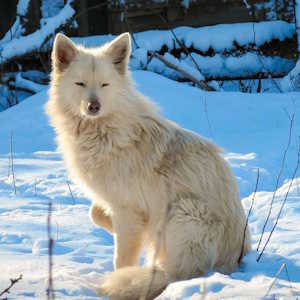 Arctic Fox
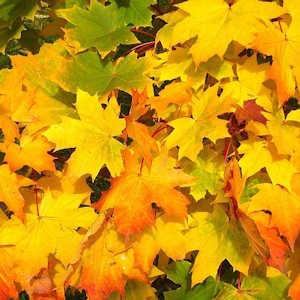 Maple
Maple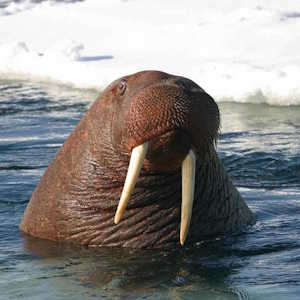 Walrus
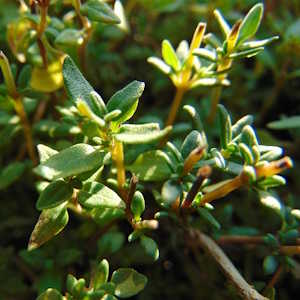 Thyme
Thyme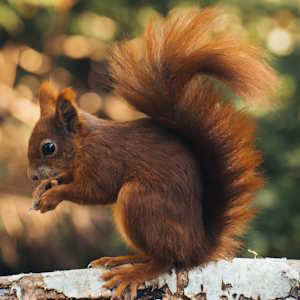 Red Squirrel
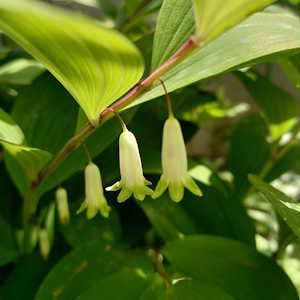 Salomons seal
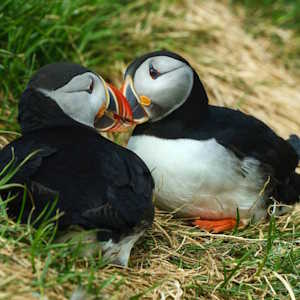 Puffins
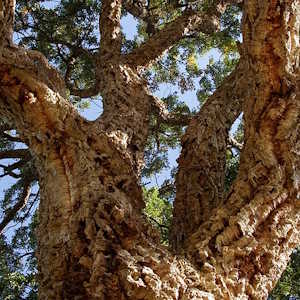 Cork Oak
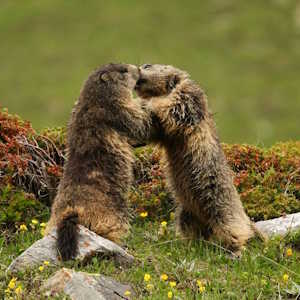 Marmot
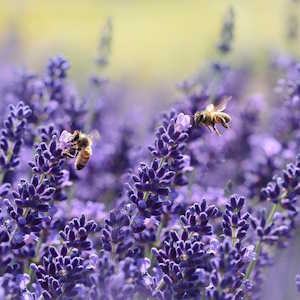 Lavender
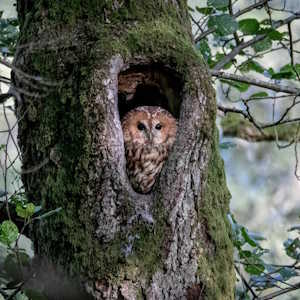 Tawny Owl
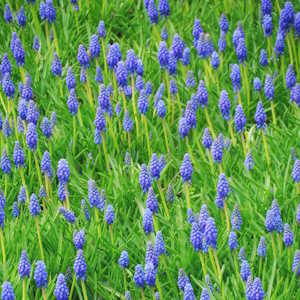 Wild Hyacinth
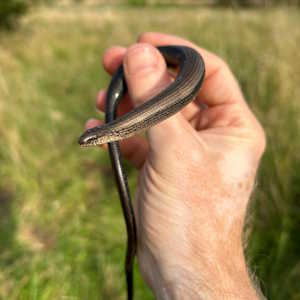 Slow Worm
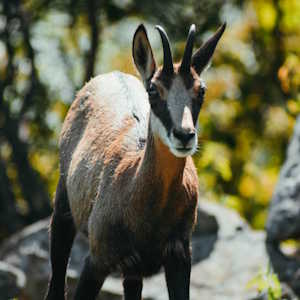 Chamois
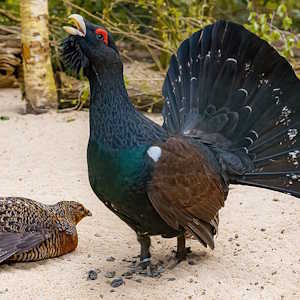 Capercaillie
Fauna
The fauna of Europe is just as diverse as its flora. Thanks to the variety of climates, landscapes, and altitudes, you’ll find animals here from true polar dwellers to Mediterranean sun worshippers. Below is an overview of the most important fauna by zone, with some iconic species.
Arctic and Subarctic Regions
- Areas: Northern Norway, Sweden, Finland, Iceland, and Svalbard.
- Mammals: Arctic fox, reindeer, walrus, and polar bear (Svalbard only).
- Birds: puffin, snowy owl, Arctic skua, and razorbill.
- Adaptation: these animals have thick fur or feathers, fat reserves, and exhibit seasonal migration or color change (e.g., Arctic fox and snowy owl turn white in the winter).
Boreal Forests/Taiga
- Areas: Scandinavia, Northern Russia.
- Mammals: brown bear, moose, wolf, and lynx.
- Birds: capercaillie, crossbill, and black woodpecker.
- Special: large predators still have relatively large habitats here.
Temperate Deciduous Forests and Cultural Landscape
- Areas: Western and Central Europe.
- Mammals: red squirrel, badger, roe deer, and wildcat.
- Birds: nuthatch, golden oriole, and tawny owl.
- Amphibians and reptiles: fire salamander, and slow worm (legless lizard also known as a deaf adder).
High mountains in the Alps, Pyrenees, Carpathians, and Caucasus
- Mammals: chamoisibex, alpine marmot, and snow vole.
- Birds: alpine chough, bearded vulture, and alpine accentor.
Mediterranean region
- Areas: Spain, Italy, Greece, southern France, and Croatia.
- Mammals: Iberian lynx (endemic to Spain and Portugal), monk seal, and genet.
- Birds: flamingo, bee-eater, hoopoe, and black-winged kite.
- Reptiles: Mediterranean tortoise and lizards (e.g., Gallotia in the Canary Islands).
Steppes and Dry Grasslands
- Areas: Southern Spain and Eastern Europe.
- Mammals: wildcat and European ground squirrel.
- Birds: great bustard, little bustard, and Montagu’s harrier. The Steppes and Dry Grasslands are hotspots for migratory birds connecting Europe with Africa.
Unique characteristics of European fauna
- Reintroductions: success stories include the return of the wolf, lynx, and beaver to parts of Western Europe.
- Endemism: many species are found nowhere else, especially on islands (Canary Islands, Madeira, and Balearic Islands) and mountain ranges.
- Migration: millions of migratory birds use Europe as a stopover or breeding ground.
What is the Best Time to Visit Europe?
Southern Europe, including Spain, Southern France, Italy, and Greece: The ideal time is in spring (April–May) or autumn (September–October) for pleasant weather and fewer tourists.
Northern Europe, including Iceland, Scandinavia, and Scotland: The best time is summer (June–August) due to the mild climate and longer days. This is also the best time for access to nature reserves.
Central Europe, including France, Germany, and Alpine countries: Spring and summer are ideal, with a peak in June and July for hiking and festivals.
Ecological Threats in Europe
Europe is a continent rich in natural resources, ranging from vast forests and mountains to wetlands and coastlines. Sadly, this biodiversity is under pressure from various ecological threats.
- One of the greatest challenges is climate change. Rising temperatures are leading to melting glaciers in the Alps, as well as warmer seas disrupting ecosystems. There are also more frequent droughts and forest fires, especially in Southern Europe.
- Habitat loss is also a major problem. Intensive agriculture, urbanization, and infrastructure projects have caused many animals to lose their natural habitats. This affects meadow birds, large mammals, and insects, among others.
- Pollution also remains a threat. Air pollution from traffic and industry affects not only human health but also forests and lakes. Water pollution from pesticides and plastic waste threatens rivers, lakes, and seas, such as the Mediterranean and the North Sea.
- Overtourism is a growing problem in some regions. Popular destinations such as the Alps, the Spanish coast, and cities like Venice and Barcelona are experiencing overcrowding that is putting pressure on local ecosystems and quality of life.
- Finally, the invasion of non-native species poses an ecological challenge. Species like the American crayfish and Japanese knotweed displace native flora and fauna and permanently alter ecosystems.
Despite these threats, Europe is strongly committed to nature conservation through networks like Natura 2000, renewable energy, and sustainable tourism. For ecotourists, this means making conscious choices:
- Travel outside peak season, so there are fewer people who visit at once.
- Support local communities and visit nature reserves with respect for the nature within.
In this way, you contribute to the protection of Europe’s unique biodiversity.
European Ecolodges and Travel Safety
As usual, when travelling, check places out for security reasons. A good resource for US citizens and others is The State Department’s website. They list Travel advisories: https://travel.state.gov/content/travel/en/traveladvisories/traveladvisories.html/
IMAGE CREDITS > Destination UK. Keswick, Lake district, no author. > Destination Iceland. Thingvellir National Park. Image by Sharon Ang from Pixabay. > Destination France. Flamingos in the Camargue. Image by Fabien from Pixabay. > Destination Spain. Andalusia. Image by Makalu from Pixabay. > Arctic Fox. Image by Olga Bochkareva on pexels.com > Maple. Image by Shirley Hirst from Pixabay. > Walrus. Image by PublicDomainImages from Pixabay. > Thyme. Image by Adrián Winter from Pixabay.
> Red Squirrel. Image by Martin from Pixabay. > Solomon’s seal. Image by junamoc from Pixabay. > Puffins. Image by Susanne Jutzeler, Suju-Foto on pexels.com. > Cork Oak. Image by Valter Cirillo from Pixabay. > Marmot. Image by Adrien Stachowiak on pexels.com. > Lavender. Image by Rebekka D from Pixabay. > Tawny Owl. Image by D H J on pexels.com. > Wild Hyacinth. Image by Afitab on pexels.com. > Slow Worm (legless lizard). Image by Thomas Nielsen on pexels.com. > Chamois. Image by Lil Artsy on pexels.com. > Capercaillie. Image by Thorsten Schulze from Pixabay.
Leave a Reply
Want to join the discussion?Feel free to contribute!